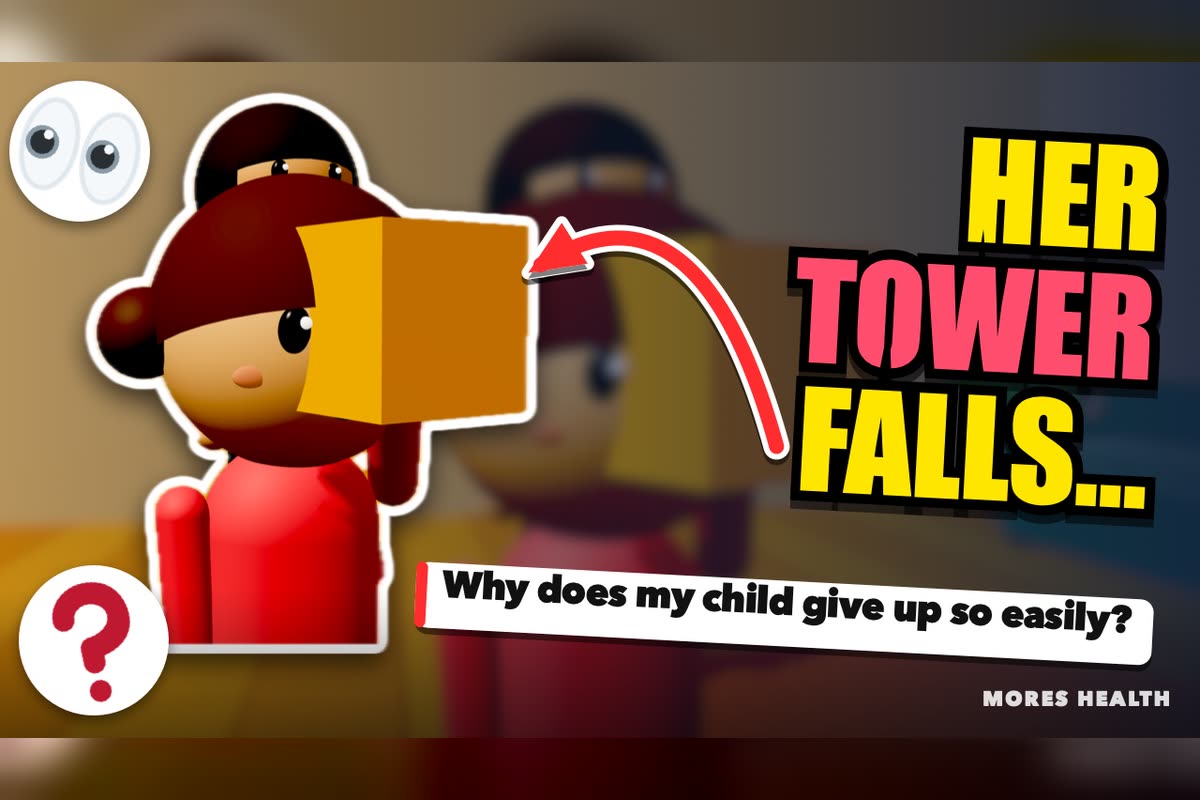
A four-year-old is building a tower of blocks. It wobbles, and falls. She looks at the pile, then walks over to the sofa. You watch and wonder: why does my child give up so easily?
The short answer is that a stop is not always the end. What looks like giving up can be a pause or a rest. Then a child may come back to the task later. In one study, how adults praised a child went along with how soon that child would give up after a failure.
So the most useful step is to watch what happens next. When a child seems to give up, the next minute often tells you more than the fall itself. Below we cover what is going on, what to watch, what research saw, and its limits.
What is going on when children give up?
Look again at the girl and her tower. When it falls, she has a few choices. She can stop and leave. She can pause, look at the pile, and start again. Or she can grab a block and rebuild right away.
From across the room, a stop and a pause can look alike. But a child who walks to the sofa may come back a few minutes later with a new plan. Another child may sit still for a while, then stack the blocks a new way. So when a child seems to give up once, that stop is a moment, not a label.
Many things shape when a child will give up on a task. The blocks may be hard for small hands to balance. Also, the time of day, the noise in the room, and who is watching can all play a part. A snack or a nap may change what happens next.
Adult words matter in this moment too. When a tower falls, a child often looks up at the nearest grown-up. What you said before the fall, and what you say after, is part of the scene. That is why the research below looks at praise.
What can I watch for at home?
You do not need a chart for this. Instead, watch the minute after something falls, and do it over several days. A pattern of stops, pauses and restarts may start to show. That pattern tells you more than any single fall.
If your child does give up and walk away, try waiting before you step in. Then, if you speak, say what you saw them do, such as ‘You put the big block at the bottom.’ This names an action, not a label.
- Notice how long your child sits or looks before touching the blocks again.
- See whether your child rebuilds the same way or picks different pieces.
- Watch whether your child walks away and then comes back later on their own.
- Look at what your child does right after you speak, praise, or help.
- Note the times of day when restarts happen and when they do not.
What does research say about why a child might give up?
The study here is Mueller 1998, a set of short lab experiments with fifth graders. The authors report several experiments, but the summary does not say how many children took part. So we cannot say how large the groups were.
In these experiments, adults praised some children for being smart. They praised a second group for their effort. Then every child had a turn that ended in failure. After that, the researchers watched how long each child kept at the task.
Children who heard praise for being smart kept going for less time after the failure. They also did less well on the task afterwards. Meanwhile, children who heard praise for effort kept going longer after the same failure. In other words, how adults praised a child went along with how soon that child chose to give up.
The children who heard praise for being smart also more often described being smart as something that does not change. Still, these were short lab tasks with older children, from 1998. The study looked at one kind of praise at a time. It also did not follow children over months or years.
What this does not tell you
This study does not tell you why your own child might give up on a tower at home. Praise is only one possible reason, and the study did not look at other causes. It also does not tell you what a quiet pause means. A child who sits still may be looking, resting, or simply done for now.
The children in the study were fifth graders, so the findings may not carry over to toddlers or preschoolers. Also, a single study is a starting point, not the full picture.
If your child stops most tasks through the day and you have questions about it, ask your child’s doctor. A teacher or childcare worker can also tell you what they see in other places.
Where Mores Health fits
Mores is a game where children build in a quiet open world. When a structure falls, Mores records the time from the collapse to the next piece placed. That is the same moment as the girl looking at her fallen tower before she walks away or starts again. This timing does not tell you what the pause was for or why it lasted as long as it did. Mores does not test or diagnose.
Questions parents also ask
Is it OK to praise my child at all?
Yes. In Mueller 1998, children who heard praise for effort kept going longer after a failure. Naming what your child did, like trying a new piece, fits with that finding.
What can I do when my child starts to give up on a task?
You can wait a little, then describe what you saw, such as ‘The tower fell when the top block went on.’ Then leave room for your child to choose what comes next.
Is a long pause after a fall the same as quitting?
Not always. A child may sit, look at the pile, and then build again. Watching the next few minutes tells you more than the pause alone.
Sources
- Mueller 1998. Praise for intelligence can undermine children’s motivation and performance.. Journal of personality and social psychology. doi:10.1037//0022-3514.75.1.33
More stories
This article describes research and everyday behaviour; it is not medical advice. If you have questions about your child, ask their doctor.
Mores Health is in early beta. Join the beta.
Written with AI assistance from the studies listed above, and reviewed by a person before publishing.